
Archange
Building your personal
development plan
This guide is available in English and French only. It follows the language of your interface, which you can change from your life board.
What this exercise asks of you: fill in every cell of your Archange board.
What it is for: clarifying the direction of your life, and turning it into something you can act on day to day.
A few reasons to do it:
- No one will do it for you, however many years you spend waiting.
- Your life will not move towards what you want if you do not know what you want.
- To have what you have never had, do what you have never done.
Watch your thoughts, for they will become your words.
Watch your words, for they will become your deeds.
Watch your deeds, for they will become your habits.
Watch your habits, for they will become your character.
Watch your character, for it is your destiny…Talmud
One aim of personal development is to become the master of your own life: to stop holding others responsible for your actions or your fate. To build a life that inspires you, and that resembles you, it helps to settle on a plan of action — one you remain free to change. You are writing your own calling, the call to become the person who fits you best. Vocare means “to call” in Latin, as in vocation, invoke, convocation… You are being summoned towards your own destiny.
Becoming a little more the master of your future asks you to commit to it in the present.
Why would filling in a board help you get what you want?
The answer lies in the brain. One region¹ automatically picks out, in your surroundings, whatever carries meaning for you: your attention is drawn, for instance, to every car resembling the model you are thinking of buying. In the same way, setting out a plan for the life you want helps your brain spot the information, the encounters and the opportunities that will, day after day, help you follow the path that suits you.
Filling in your board
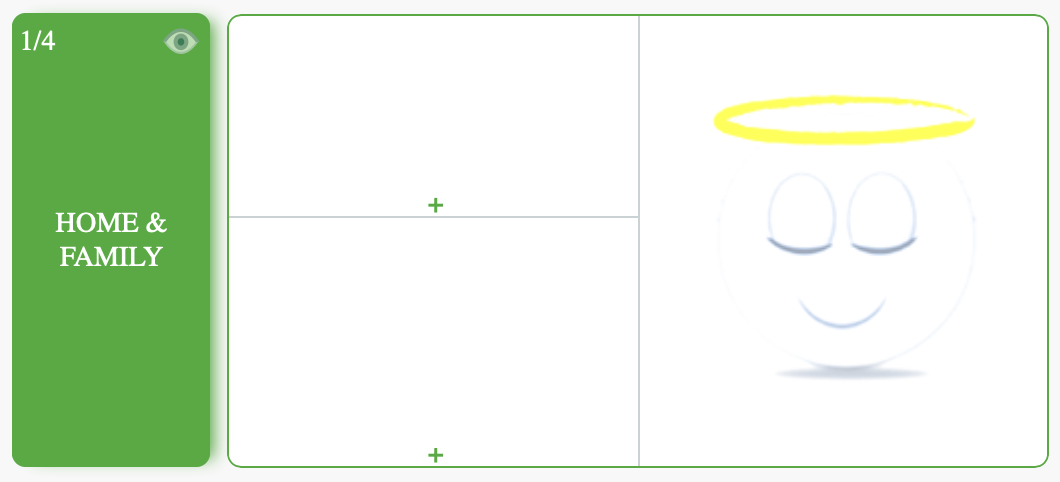
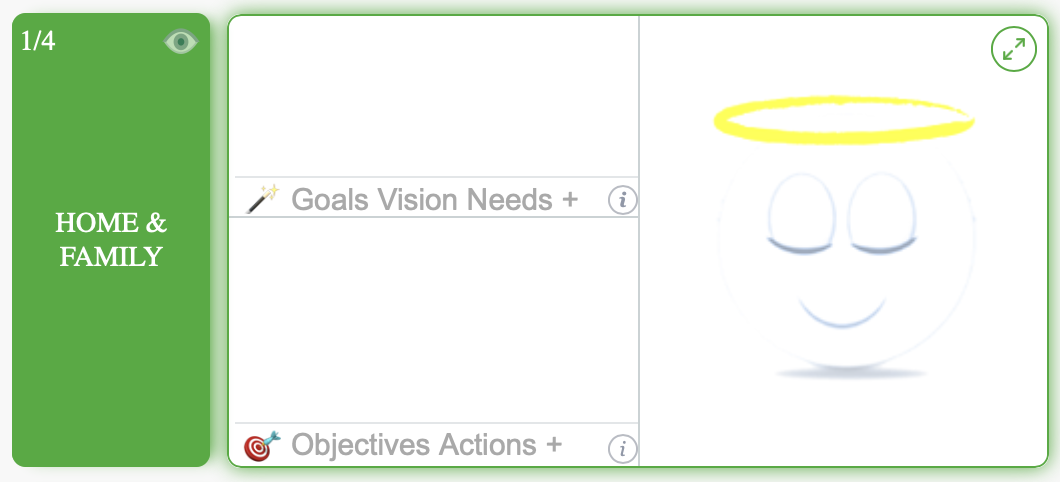
1. Goals
Goals are the upper zone of the card, marked by a star. This is where your vision goes: what you would reach for if everything were possible.
Picture yourself in the situation you dream of reaching, as though there were no limits, as though you held a magic wand. Only by allowing yourself to look past what seems realistic will you start to feel the small flame that moves you. If nothing comes, here are several ways in:
- Try things. Experiment with what exists in this world — at random sometimes, in keeping with your values above all.
- Notice what draws you to the people who inspire you, and try following their example.
- Try things that match your own sensibility: bodily, emotional, intellectual, cultural, social, material.
- Answer the lacks you know in yourself — those parts of you that seem to be waiting, that you would be glad to see grow through contact with the world. Those parts you feel to be isolated, without a guide, folded in on themselves; try becoming the guide or the parent of those parts, offering them things to live, arranging the life that will let them grow. In short, offer a life to the pains you carry.
Then write that vision into the card. As you write, try to feel the emotion attached to it. Emotion helps the brain remember, and spot more readily in the world around you whatever serves what you are building. As far as you can, aim for a burning desire rather than a reasonable wish.
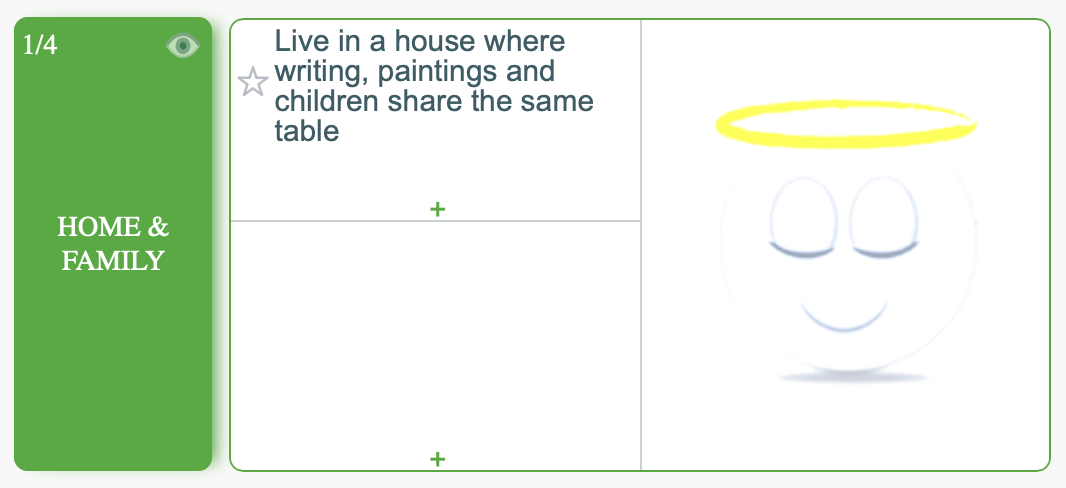
Do this for every domain of your life, and fill in the three horizons — short, medium and long term. It matters that others have a place in your vision: you will then be able to plan how your life might improve through what you share with those around you.
A few questions to guide you: what would my surroundings look like in this domain? What would I ideally want to bring to others? What could I do for others that I would like done for me?
To put it simply
A goal is what you can feel.
An objective is what you can touch.
2. Objectives
Objectives are the lower zone of the card, marked by a circle. They are the actions that will carry you towards the goal above them — and you will only be sure they do once you have taken them.
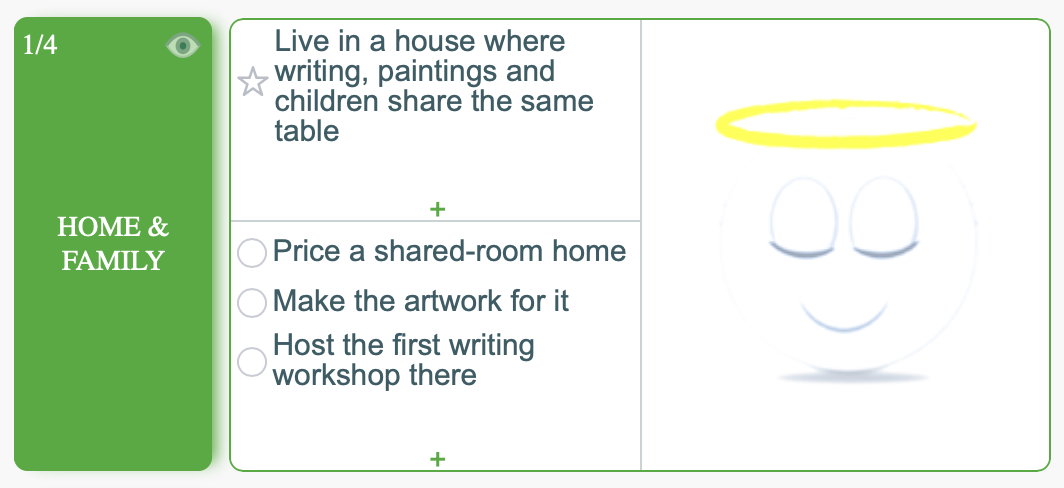
Word them concretely. An objective may be a course to take, an activity to try, a meeting to ask for, a journey to prepare. Where a goal is felt, an objective can be touched: the telephone you pick up to enrol, the arms of someone you love, a book to read, a floor to walk on.
- The first useful objective is very often to read up on the matter — time spent there is usually time gained.
- Better still, plan to call on someone who has done it before: a teacher, a trainer, a practitioner, a mentor. A whole inheritance of experience exists in humanity, and it would be a pity to walk past it.
- Choose objectives that sit a little outside your comfort zone, so that each one grows you slightly.
- But keep them within reach, by small steps. Everyone knows how discouraging a knockout in a first boxing match would be: start at your own measure.
- Where it helps, estimate roughly what this objective will cost you in daily life — the price to pay — and ask yourself whether you are willing to pay it.
3. Two kinds of line that are not objectives
Among your objectives, two prefixes change the nature of the line. Both lose their circle, because neither is something you tick off once and for all, and both rise to the top of the list.
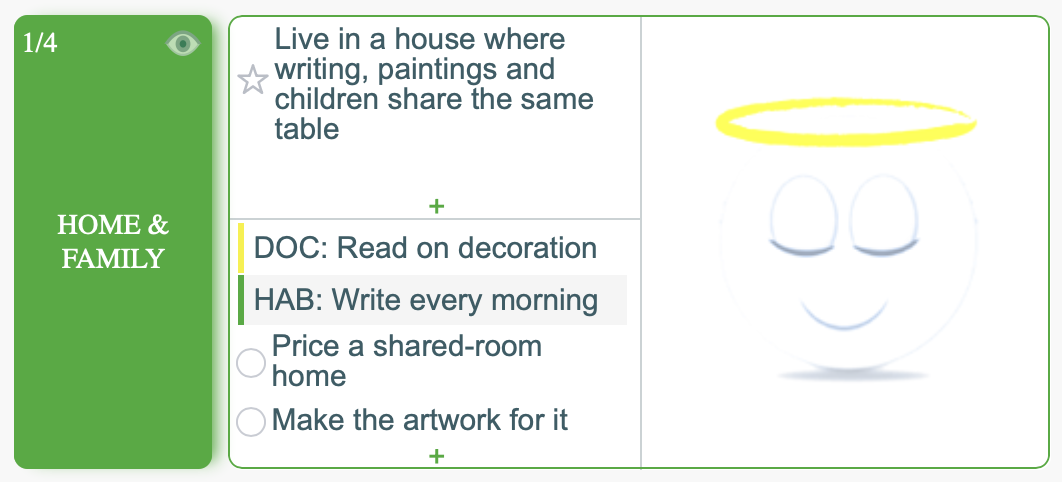
HAB: marks a habit — something you intend to do again and again, not to finish. A habit has no end date, so it would make no sense to cross it out; it sits there as a standing part of this domain.
DOC: marks a reminder to read up on the goal before hanging objectives under it. It answers the advice given above: the first useful step is almost always to find out what is already known. Keeping it in sight spares you from building a plan on what you merely assumed.
4. Picture your goal
Archange lets you attach an image to each of your domains, in the area on the right of the card. Choose one that shows what you are aiming at, rather than one that merely decorates.
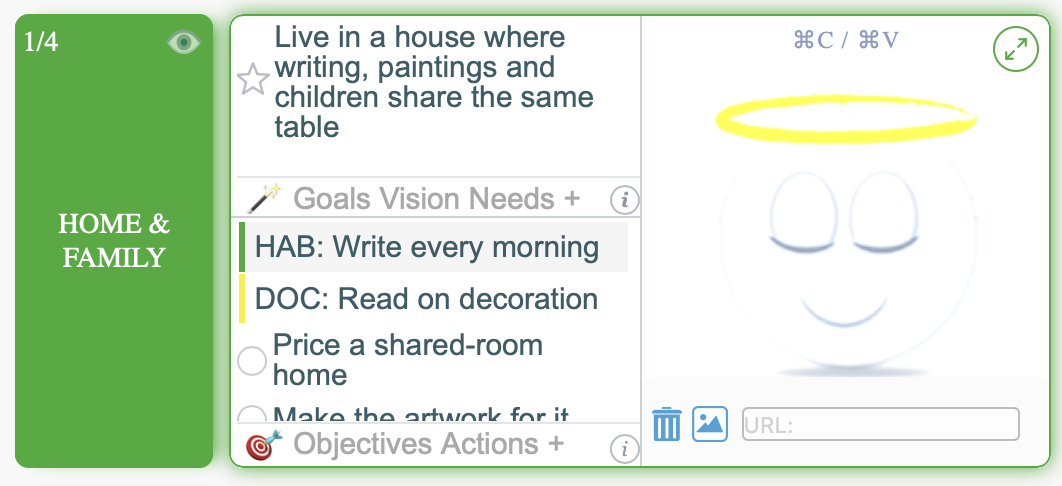
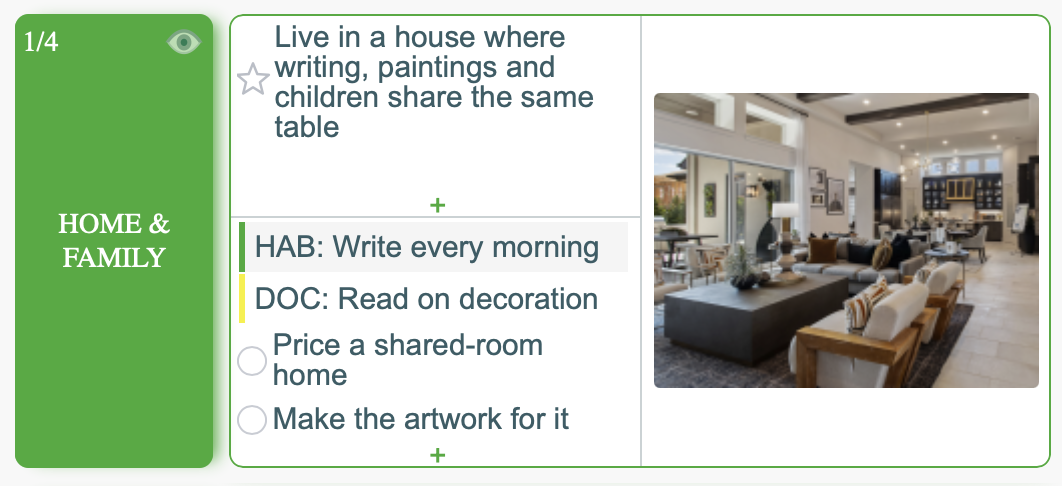
Those images gather in your vision board, reached by the icon at the top right of the screen. Some people go further and build a physical one on a wall, with pictures, quotations that match their values, anything that keeps the desire awake — the principle is the same.
What this board is for is simple: never to lose sight of the calling you have written for yourself. It keeps a link alive between your goals and the objectives that lead there. You can even set the vision board as the page your browser opens on.
Images and vision board also guard you against the drifts that may come: ways of living centred on more immediate pleasures — the reign of the limbic brain — whose usual consequence is to disinvest that Archange within you, the organising brain, the frontal lobe. This imbalance between immediate pleasure and longer-range vision has been identified as bound up with the low spirits of everyday life.
A personal development plan thus embodies a voice, a word spoken. Like a mirror set in front of you, the vision board reminds you of your vision and of the road you had meant to take.
5. One objective above all others
At the top of your board sits a single field, apart from the domains: your main objective. One sentence, which you read before anything else each time you open Archange.

Its use is not to summarise your plan — your domains do that — but to name what, in the months to come, must take precedence when everything cannot be done at once. A board tells you where you are going; this line tells you what comes first.
Keep it short enough to be read in one glance, and change it whenever the season of your life changes. It is the one part of the board meant to be rewritten often.
And then… take action
Taking the time to design your programme is a commitment
Filling in this board, little by little, at your own pace, then adjusting it after each experience, takes an effort — and that effort is necessary. It means becoming, day after day, a source of inspiration for the small being within you who has been waiting all this time to live and to come into its own. It is something like the work of a parent, turned towards yourself. It is also a head start for the day you help your own child organise their life.
The task may look tedious; you will come to take real pleasure in it.
Fill in each column — short, medium and long term. The path towards the distant is built now, especially for the most demanding projects. Whoever wants an oak must plant it today.
Only by choosing a direction do you begin to choose a road.
Act
If this programme stayed on the screen, you would be using half of it. So act.
Action is central: it is how we come into our own, and more than that, it teaches us what we want and what we do not. Multiplying experiences raises your chances of finding yourself, and so of refining the plan itself.
Giving yourself value, giving value to your life, is trying to define the place you wish to hold. It is offering yourself the prospect of becoming who you are, and honouring the time you have been given. It is betting on the discovery of your own happiness.
Dare to act. Dare to step outside your comfort zone. Dare — for yourself.
This approach is therefore a guide for learning to build yourself, and for remembering easily the direction you have chosen, against those flat spells we all know, where one loses sight of one's own line and returns to the solitude of the child who starts waiting again. Remember this too: an action that carries us forward is very often an action involving someone else.
Changing your plan once the objectives have been put into practice
- What you learn from your first completed actions will change your vision, and bring you closer to yourself.
- It will change your objectives too, letting you choose actions that fit you better.
A worked example
Taking the domain of the home.
- Name the reason. « Right now, my home brings me no real joy. »
- Write the short-term goal.
- For myself : « I picture myself breathing freely in a bright home with generous volumes. The front step opens straight onto a sunlit stretch of grass. »
- For the others : « A warm living room, with cushions on the floor and wooden furniture… »
- Write the short-term objectives.
- Find out the prices of that kind of home.
- Find out about homes that partly meet those conditions.
- Look into wooden furniture, and ask those who know where to find it.
- Attach an image close to that home to the domain, so it reaches your vision board.
- Fill in the medium and long term for the same domain.
- Fill in the other domains.
- Act.
- Adjust goal and objectives in a few months, as needed.
A metaphor to close with
The vision is imagining the house you would like to have, as precisely as you can, in every domain it involves.
The plan is drawing out what each craftsman of your life will do to lay the materials of that house.
Action is laying each stone. Having pictured it first, and drawn a plan, spares you from working by trial and error — because moving a wall once it stands is exhausting. Learning to plan your own construction is therefore essential.
Adjustment is revising vision and plan as the work advances, and as life reveals what you had not foreseen. Then adapting what you build next.
Wishing you a fine exploration.